Are we Cooked?
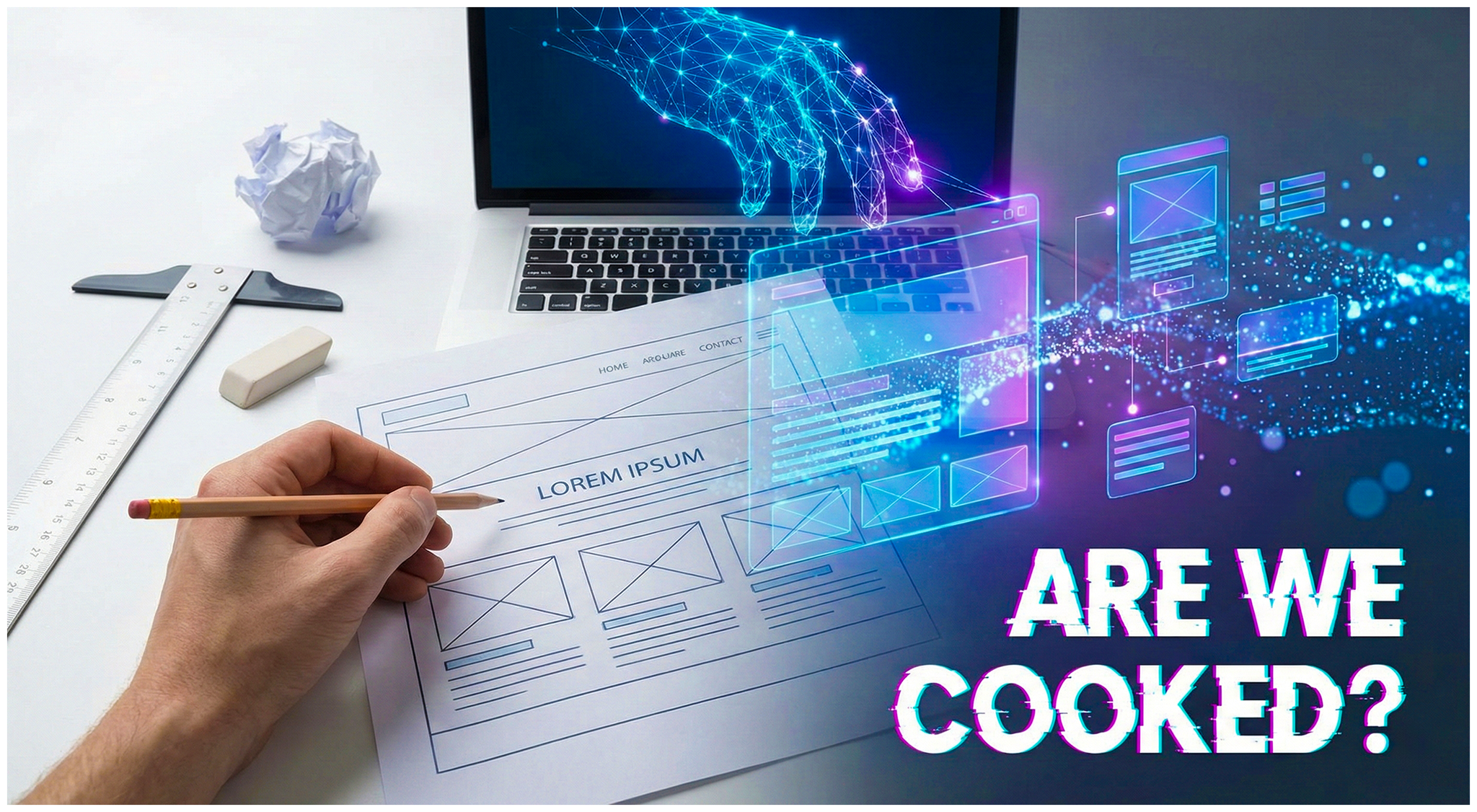
For many, the relentless news cycle surrounding Artificial Intelligence has become white noise. Between the hyperbolic headlines and the technical jargon, it is easy to become desensitized to the "revolution" supposedly unfolding in real-time.
But a recent conversation on the Moonshots podcast got me thinking.
The discussion moved beyond the typical futurist speculation and grounded itself in hard data, specifically the unit economics of modern knowledge work. It forces us to confront a vernacular question that has been circulating with increasing anxiety in professional circles: "Are we cooked?"
If we define "we" as contributors relying on traditional, linear workflows, the economic indicators suggest the answer is precarious. Here is the analysis.
We need to look past the novelty of chatbots and focus on the productivity benchmarks. The podcast detailed the "GDP Eval" study, which compared human professionals against current AI models across a spectrum of standardized knowledge tasks.
The divergence in performance is not merely incremental; it is structural.
Quality: The AI output was rated superior to human output in 71% of trials.
Velocity: The AI completed tasks at over 11 times the speed of its human counterparts.
Cost: The AI executed the work for less than 1% of the cost.
In economic terms, this represents a complete disruption of the labor market equilibrium. When a substitute good becomes superior in quality, an order of magnitude faster, and effectively free, the market does not simply adjust; it undergoes a phase change. For roles defined by execution and processing, the competitive advantage has decisively shifted to silicon.
Peter Diamandis offered a sobering projection based on these metrics: 2026 may witness a historic corporate correction.
This prediction stems from the friction between two opposing forces: the exponential curve of technological capability and the linear nature of organizational change. While AI models improve at a compounding rate, legacy institutions grapple with bureaucratic inertia.
The risk is that by 2026, the delta between "AI-native" firms (leveraging 11x speed and <1% cost) and legacy incumbents will become insurmountable. Organizations that attempt to graft these tools onto outdated hierarchies, rather than rebuilding their operational stacks, face an existential threat.
Perhaps the most profound disruption, however, lies in the creative sector. The podcast posits that we are approaching a reality where "every pixel on a screen will be AI-generated."
This signals a violent shift in the locus of design itself.
For decades, the profession has been defined by "production," the manual arrangement of vectors, the setting of grids, and the crafting of static artifacts. We taught designers to be bricklayers. But if the interface is generated in real-time by an AI to suit a user’s specific intent, the "bricklaying" is abstracted away.
The role of the designer does not disappear, but it migrates upstream. We are moving from a paradigm of drawing to a paradigm of governing. The value no longer lies in the pixel-perfect execution of a single screen, but in defining the constraints, the logic, and the "source of truth" that the AI uses to generate that screen. We are no longer designing the output; we are designing the machine that creates the output.
So, does this imply obsolescence?
If one’s professional identity is tethered to the manual execution of tasks, whether that is writing code syntax or pushing pixels in Figma—the outlook is undeniably challenging. However, this shift also represents a lowering of the barrier to creation.
As the marginal cost of intelligence approaches zero, the value shifts from doing to directing. The "operator" competing against the algorithm faces a losing battle; the "architect" who orchestrates these tools gains unprecedented leverage.
The data indicates that the era of manual knowledge work is drawing to a close. The era of high-leverage direction has just begun.