Al Dente: We Are Cooked!
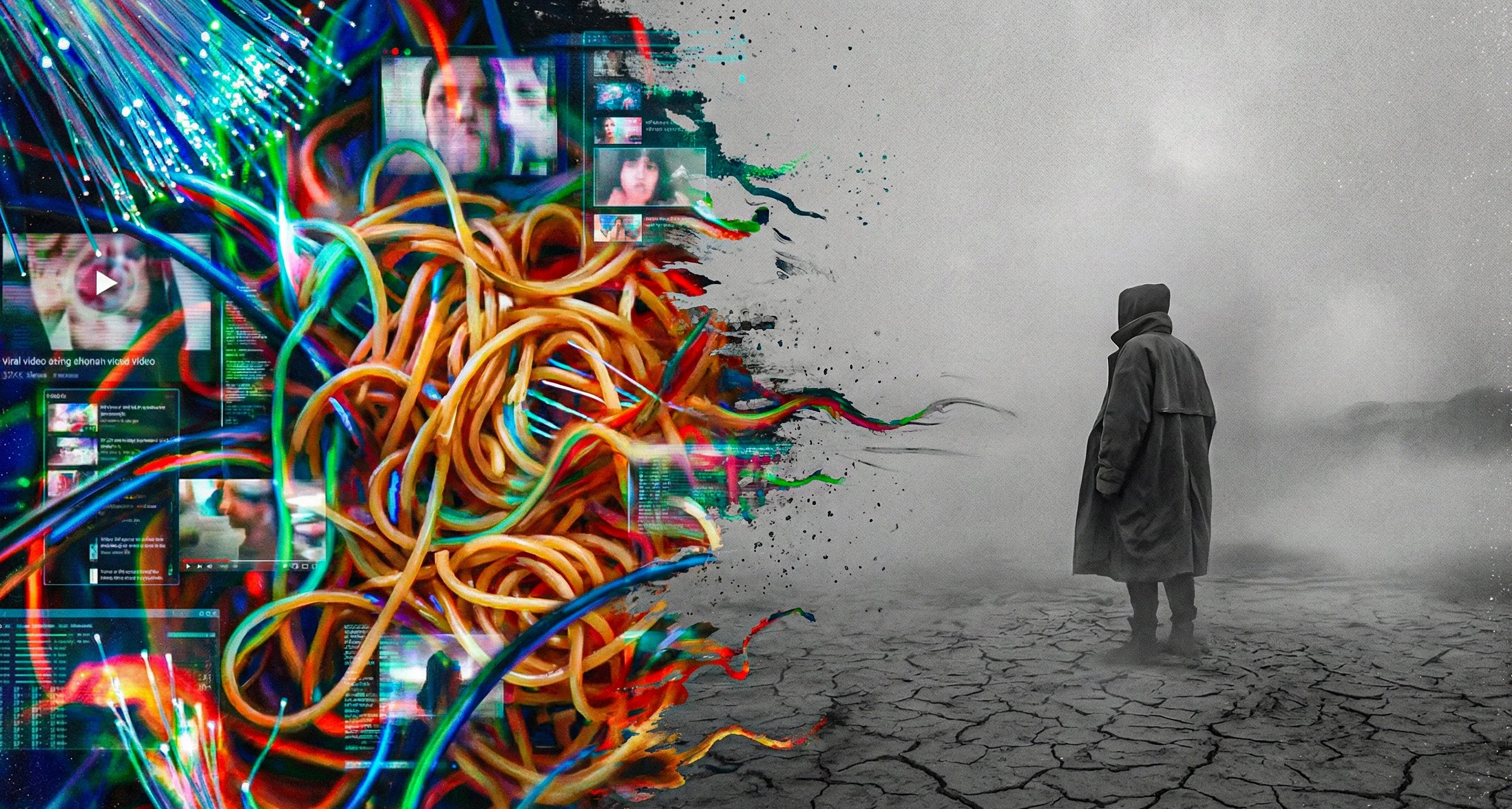
Most people don’t remember the technical details of the first Will Smith spaghetti video. They remember how bad it was. The fork kept melting into the noodles, the mouth negotiated several possible locations for eating, chewing happened somewhere near the face but not quite inside it, and gravity occasionally gave up. You watched it once, maybe twice, laughed, and mentally shelved it as impressive but nowhere close. The important part wasn’t the failure itself. It was the timeline your brain quietly extracted from it.
Now Seedance 2.0 is circulating outside AI circles and the tone is different. People who do not follow models or benchmarks are sharing clips with uncertainty instead of amusement. The Tom Cruise and Brad Pitt fight works not because it is perfect but because it behaves correctly long enough to pass an unconscious plausibility check. Lighting stays coherent across cuts, camera movement feels motivated rather than simulated, bodies carry weight for just long enough that recognition precedes doubt. That tiny temporal gap where acceptance arrives before skepticism is the real threshold that moved, not realism in some absolute sense but believability in practice. Industries react to that, hence legal responses already appearing, because persuasion does not require perfection, only stability.
The important milestone is not capability but sufficiency. Most public conversation still tracks power curves, bigger models and smarter outputs, but daily life reorganizes around diffusion instead. Diffusion is when a system stops presenting itself as a tool and instead becomes a property of the environment. It embeds inside familiar interfaces, arrives bundled inside subscriptions, becomes a toggle, then a default, then an assumption nobody bothers to name. Once there, evaluation shifts from “is this impressive” to “why would I not use this,” and adoption accelerates even while imperfections remain obvious to specialists. Power reshapes demonstrations. Diffusion reshapes behavior.
That is why certain recent statements land harder than typical futurist speculation. Mustafa Suleyman describing large portions of computer mediated white collar work compressing within roughly 12 to 18 months and Dario Amodei warning about entry level erosion within one to five years are less interesting as predictions than as reflections of observed velocity inside the companies building these systems. The credibility does not come from certainty but from proximity to iteration cycles that the public only glimpses indirectly. We have repeatedly treated each step as isolated novelty and then retroactively recognized a pattern only after the baseline moved again.
Disruption here will not resemble a single moment of replacement. It accumulates through ordinary optimization. A support team handles triage automatically and escalates edge cases, a consulting draft appears before a meeting instead of after, legal review begins from machine summaries rather than blank reading, marketing experiments scale by orders of magnitude. Each change individually feels rational and contained, yet collectively they shrink the apprenticeship layer of knowledge work. Entry level labor is structurally exposed not only economically but developmentally, because repetition was the training ground where judgment formed. Remove enough repetition and you alter how expertise matures rather than simply how fast tasks execute.
Adoption historically follows thresholds rather than announcements. Reliability reaches the point where managers stop double checking everything, integration removes the friction of new platforms, economics eliminate justification for abstaining. At that moment the choice disappears socially even before it disappears technically because competitive pressure enforces alignment. Teams rarely decide to transform simultaneously, but once a few cross the threshold the rest inherit the pace whether or not they agree with it philosophically. The timeline debate therefore matters less than the direction of travel.
Many people still approach AI as a category of software to learn and master, comparable to picking up a new creative suite or upgrading hardware, yet the operative change is the instability of the baseline itself. Expectations update continuously, not after adoption but during it, which means competence becomes a moving target rather than an achievable state. The last three years demonstrate this compression clearly: visible failure, then partial coherence, then stable motion, now contextual plausibility. Cultural literacy is currently the primary defense against misinterpretation, but literacy scales slower than distribution.
The practical response therefore shifts from prohibition to evaluation. In teaching it means rewarding reasoning, traceable iteration, and accountable decision making rather than mere production volume because generation cost collapsed while selection cost did not. In professional contexts it means redesigning workflows instead of optimizing participation within them, understanding where automation introduces risk as much as speed. At the organizational level it requires explicit alignment between policy and behavior because informal adoption already occurs regardless of official stance.
None of this requires speculative superintelligence. Continued incremental improvement combined with embedding into existing infrastructure is sufficient to alter norms. The unsettling part is not acceleration itself but normalization of acceleration, the moment progress stops feeling exceptional and begins feeling ambient. The spaghetti clip marked a collective reassurance that the boundary between synthetic and believable was distant. Its obsolescence is the signal. The question is no longer whether media convinces but how quickly convincing media becomes routine enough that nobody pauses to ask anymore.