The Future Just Showed Up in My Browser
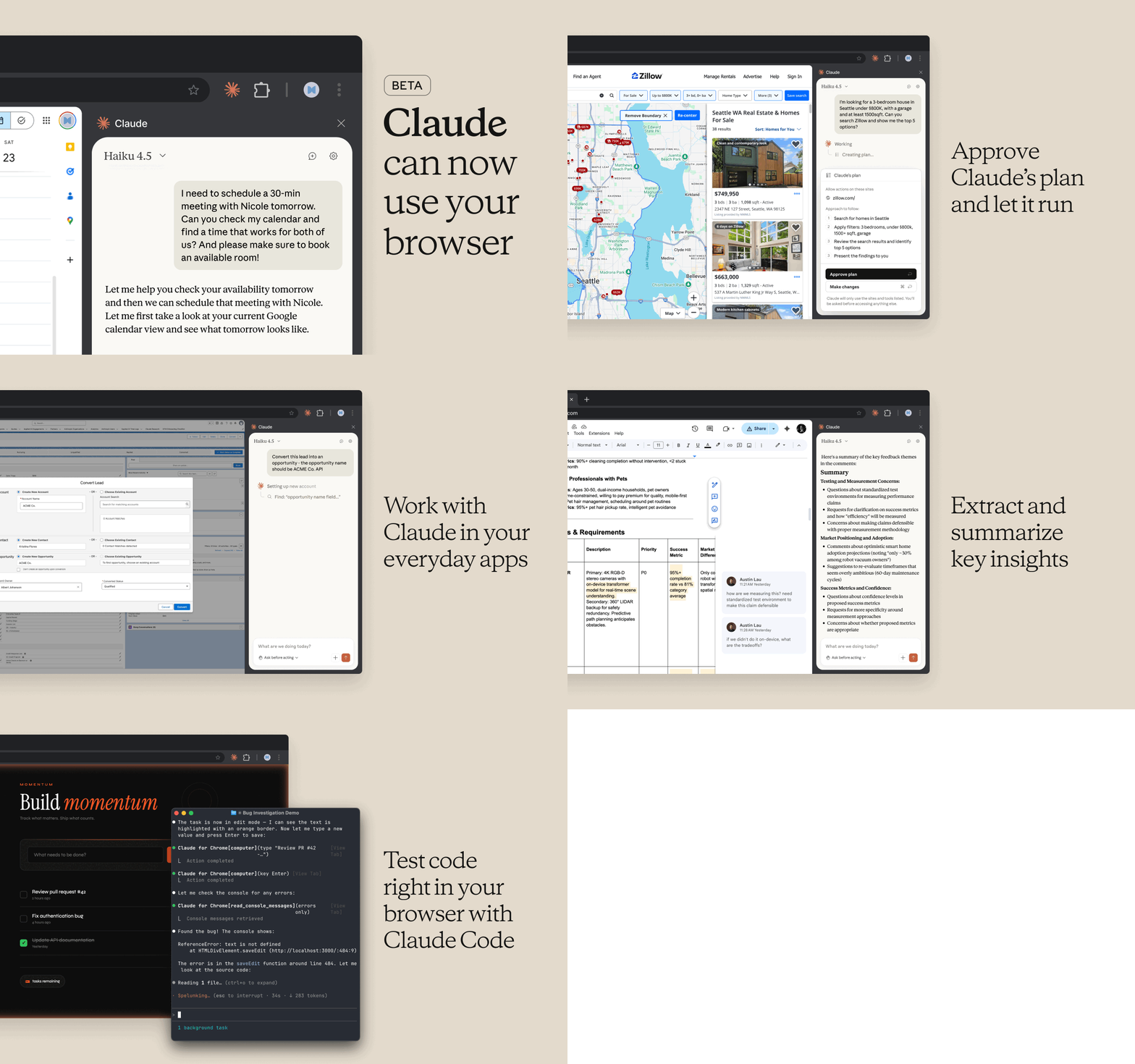
There’s a newish feature in Claude called Claude in Chrome. It connects Claude directly to your browser, giving it the ability to see what you see, navigate pages, read content, and interact with your site the way a human collaborator would. Except faster. And with a very different kind of attention.
I’ve been using it to review one of my websites for SEO issues, and the experience is worth talking about. Not because the tool is perfect, but because the way it works signals something meaningful about where all of this is heading.
What Actually Happens
Here’s the setup. You open your site in Chrome. Claude can see the page. Not a pasted block of text in a chat window, not a screenshot you uploaded. The actual live page, in your browser, rendered as it would be for any visitor.
Then you ask it to look for problems.
What happens next is the part that catches you off guard. Claude starts navigating. It moves through your site, page by page, reviewing structure, reading meta descriptions, checking heading hierarchies, flagging missing alt text, noting inconsistencies in how content is organized. It asks clarifying questions along the way. “Is this page meant to be a landing page or a blog post?” “Do you want this keyword prioritized over that one?”
It’s not just scanning. It’s reasoning about what it finds. And it does this in real time, in your browser, while you watch.
The Approval Loop
Here’s the part that matters most to me, and probably should matter most to anyone paying attention.
Before Claude makes any changes, it asks. Every time.
It doesn’t silently rewrite your meta description. It doesn’t swap out a heading tag without telling you. It presents what it found, explains why it thinks a change would help, and then waits for you to say yes. Or no. Or “let me think about that.”
This is a design choice, and it’s a significant one. In a world increasingly anxious about AI acting autonomously, this approval loop is a trust architecture. The machine proposes. The human decides. That’s not a limitation of the tool. That’s the point of the tool.
If you’ve followed any of my writing or teaching, you’ll recognize this dynamic. It’s the same principle I explore with my students in courses like ART 209, where we investigate what happens when authorship is shared between a human and a machine. The answer, consistently, is that the most interesting work happens when both parties have a role. The machine generates, suggests, iterates. The human evaluates, directs, decides.
Claude in Chrome operationalizes that idea in a professional context.
From Asking About to Working On
This is the shift worth naming explicitly.
For the past couple of years, most of us have been using AI in a conversational mode. You paste something into a chat window. You describe a problem. You get a response. It’s useful, but it’s bounded. The AI is always one step removed from the thing you’re actually working on.
What Claude in Chrome does is collapse that distance. You’re not describing your website to an AI and hoping it understands the context. The AI is looking at your website. It’s navigating your pages. It’s seeing what your visitors see. And then it’s making specific, contextual suggestions based on what it actually found, not what you told it.
That’s the jump from conversational AI to agentic AI. And once you experience it, the old way of working feels immediately slower.
What This Means for Creative Professionals
I spend a lot of time thinking about how these tools reshape creative workflows. That was the core of my talk at the DDX Conference in Dubai, “Rethinking the Creative Stack,” and it’s central to the curriculum I’m building at Zayed University.
What Claude in Chrome represents is another layer of the stack being renegotiated. SEO audits used to require either specialized knowledge or specialized software (or both). Now they require a conversation. A directed one, with an AI that can see your work in context and reason about it with you.
That doesn’t eliminate the need for expertise. You still need to know what good SEO looks like to evaluate the suggestions. You still need editorial judgment. You still need to understand your audience. But the barrier between “knowing what to fix” and “actually fixing it” just got significantly thinner.
The Bigger Picture
I keep coming back to the same observation across all of these developments. The interfaces between human intent and machine capability are getting shorter. The distance between having an idea and executing it is compressing. And the tools that are winning are the ones that keep the human in the loop, not as a formality, but as a genuine decision-maker.
Claude in Chrome is a small, specific example of a much larger pattern. The AI doesn’t replace you. It sits beside you, looks at the same screen, and offers to help. And then it waits for you to decide.
That’s a model worth paying attention to. Not just for SEO. For everything.